Saturday, 15 March 2014

A week in which a lot happened.


I mentioned some time ago that I have been feeling increasingly unhappy at my paid work and have been looking for ways to re-balance my life with more of the creative work that I love. Last year I gained my PTLLS qualification through Artworks Creative Communities  allowing me to teach and take workshops sharing my love of ceramics and making in general.

This time last week I was in the middle of my first Hive/WEA weekend workshop teaching coloured clay techniques.


I’ve been planning & preparing for this class since last autumn, so I was confident that I knew my subject well, but this was the first time I would be tested with a class. I was quite nervous to start with, and this increased when the WEA assessor arrived to see how I was getting on. In the event everything went well, I was quite overwhelmed by the talent and enthusiasm of the class. They made some wonderful pieces, everyone added their own different talents and approaches to the basic technique producing varied and exciting work, and I learned as much as everyone else did last weekend. If I can I’ll post pictures of the work when it is fired. In the meantime here are a few of my own coloured clay pieces.


I felt very privileged to be teaching, and I think other people thought I had done alright as well. On Monday immediately after the coloured clay weekend I was asked & agreed to step in to teach the Sewing Bee at Hive on Fridays at short notice. Sewing?, well I’ve always sewn, practically since childhood. My interest then was in making patterns; firstly for dolls and then for myself, soft furnishings and upholstery. 
 
Nowadays I use pattern making and fabrication techniques in model making, fabricating from sheet tin and soldering in place of sewing, and in clay when creating vessels and objects from rolled clay sheets. I've always been interested in print and fabric design, here I've taken inspiration from 1950's textile patterns and interpreted them in coloured clay.

 
I've applied to teach more ceramics courses at Hive next year, so watch this space for more news, and if the Sewing Bee is a success perhaps I could call myself Ceramifabricals. 

Saturday, 22 February 2014

Tea Rex

I have a number of projects on the go at once, as one finishes and another starts and others roll on. Here's one that has just (nearly) finished.

It's been on the go for a few months - working slowly, looking for and finding just the right pieces and making custom accessories. 

Here it is:


And here is a look back at  work in progress.


Legs ready to go.
Taking shape in the workshop
Nearing completion and the pilot has been engaged
A few adjustments needed.
First test flight
Safe landing


Tea Rex


Thursday, 21 November 2013

Random musings and connections


I like to work in a quite random fashion, flitting from one theme to another. Sometimes when I take a second or sideways look I see the most surprising connections.
 

I have been photographing a recent piece, my chicken dish, another coloured clay piece. 


Whilst I had my camera out I photographed the latest project taking shape on my work table.


And the connection? Which came first; the chicken, the egg or the dinosaur?


Monday, 4 November 2013

Coloured clay success


The experimentation with coloured clay is producing results. Above is a selection of pieces fired to earthenware, the colours of the clay brought out with clear glaze. Below is an inlaid clay dish that I am particularly pleased with.


The first pieces to be finished have generated more ideas to try. I made two similar shallow dishes decorated with inlaid clay and textured by drawing into the designs with sharp points. After biscuit firing both dishes were painted and the texture enhanced with cobalt oxide before glazing and firing. Above is a dish fired to earthenware, the glaze has brightened the colours and  the cobalt has produced a bright blue wash effect, and below is the other dish fired to stoneware, the colours are much  darker and more muted. I like both dishes for their different qualities and will be firing more pieces to stoneware.


Not all transparent glazes are the same. Above are two different transparent earthenware glazes. On the left is a traditional  recipe from Emmanuel Cooper, the brightness of this glaze is achieved using fritted lead, so work is not food safe. On the right is a commercially produced glaze which is food safe but has a tendency to be a little opalescent and colours are not as bright. The intended use of a piece will determine which glaze to use, and prompts much musing on the debate between beauty and usefulness. I want both, so will try to find a glaze that delivers both.  

And between working with glazes and other projects I'm still beavering away finding inspiration in fabric and wallpaper designs from the 1950's, like these from Lucienne Day and Marion Mahler.


Monday, 16 September 2013

Bronze Age Potters.

Just back and still smelling faintly of woodsmoke having spent the weekend with friends and their families experimenting with making pots and firing them in the open as Bronze Age potters would have done.  Without having an actual Bronze Age potter to hand to help us get things right, we tried out a theory about how they fired their pots proposed by Bill Crumbleholme, You can see his U Tube video here.  Beakerfolk Amesbury Archer Beaker Firing.

When we started we hoped to finish with some usable pots, if we were lucky we might even be able to use them for breakfast. Whatever happened we would have a good time.


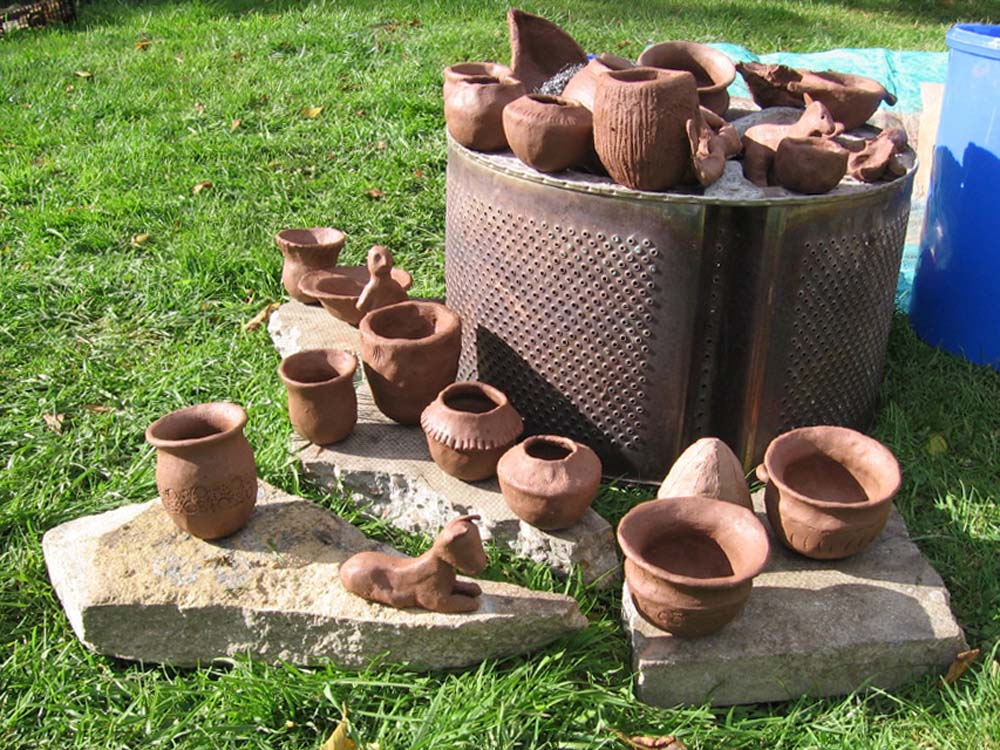
Mid-day on Saturday, we started making our beaker style pots using a mixture of grogged clays. All the pots, and a few small sculptures, were hand built by pinching, some had additional coils added and nearly everyone had the urge to add decoration. We aimed to be as authentic as possible so tools were anything of a natural and non metal origin and included shells for scrapers (mussel shells were excellent) bone, wood and stone burnishers.


It was important to make sure the pots were completely dry before attempting to fire them. 


When the BBQ was lit to cook tea it seemed natural to move the pots to the heat to dry them further. Underneath the fire bowl was ideal. The pots were tended and turned to ensure even drying.


Dusk and firing started. The fire was lit and burned for a while to dry and heat the ground, the ashes were raked aside and the dry pots placed in the centre. As the pots heated up the fire was brought closer and closer to the pots.


When the fire was touching the pots it was built up and carefully heaped over over the pots.


Everyone tended and stoked the fire as it burned fiercely for a couple of hours. If we peered into the flames we could just see the edges of pots glowing orange and for the first time we dared to hope that we would have usable pots at the end of the process.


When the fuel ran out the fire was allowed to die down. Some time after midnight the pots were cooling sufficiently to start bringing them out of the ash. The ashes were carefully raked aside and the newly fired pots revealed. They had fired well with very few "accidents"; judging from the character of the pots the fire probably reached a temperature around or just above 800C.


We had a load of usable pots, the following morning tea* was drunk from the small beakers and  Rachel had breakfast in her new bowl. It had taken just about 12 hours for a lump of raw clay to become a handsome and functional bowl.

What a fantastic weekend, many thanks to Rachel from Hive for inspiring the event and  Georgina and Phil at Hebden Bridge Camping for letting us turn their campsite into a Bronze Age pottery camp. 

* not strictly authentic.